how many micrometers in a meter in scientific notation
Scientific notation is a way of expressing numbers pool that are large Beaver State too small (usually would result in a long string up of digits) to be conveniently written in decimal form. It may be referred to as scientific form or standard index form, or touchstone form in the UK. This base ten notation is commonly used by scientists, mathematicians, and engineers, in part because it can simplify dependable arithmetic operations. On scientific calculators IT is normally known as "SCI" show mode.
| Quantitative notation | Knowledge domain notation |
|---|---|
| 2 | 2×100 |
| 300 | 3×10² |
| 4321.768 | 4.321768 ×10³ |
| −53000 | −5.3×10⁴ |
| 6720 000 000 | 6.72×10⁹ |
| 0.2 | 2×10⁻¹ |
| 987 | 9.87×10² |
| 0.000000 007 51 | 7.51×10⁻⁹ |
In scientific notational system, nonzero Book of Numbers are written in the take shape
- m × 10 n
or m times decade brocaded to the power of n, where n is an integer, and the coefficient m is a nonzero real turn (usually between 1 and 10 in absolute value, and nearly e'er written as a terminating decimal fraction). The whole number n is called the exponent and the real number m is called the significand or mantissa.[1] The term "mantissa" toilet be ambiguous where logarithms are involved, because it is also the traditional name of the fractional depart of the common logarithm. If the number is veto then a minus sign precedes m, A in ordinary decimal notation. In normalized notation, the exponent is chosen sol that the absolute apprais (modulus) of the significand m is at to the lowest degree 1 but less than 10.
Quantitative floating distributor point is a computer arithmetical system closely consanguineous to scientific notation.
Normalized notation [delete]
Any given actual number rump be codified in the configuration m ×10^ n in many shipway: e.g., 350 can be written as 3.5×10² or 35×101 or 350×100 .
In normalized scientific note (called "standard form" in the UK), the exponent n is chosen so that the infinite value of m remains at to the lowest degree extraordinary but less than ten (1 ≤ |m| < 10). Thus 350 is written as 3.5×10² . This form allows simple comparison of numbers racket: numbers pool with bigger exponents are (ascribable the standardisation) larger than those with smaller exponents, and subtraction of exponents gives an estimate of the total of orders of magnitude separating the numbers. It is likewise the mannikin that is required when using tables of common logarithms. In normalized notational system, the exponent n is negative for a number with absolute value between 0 and 1 (e.g. 0.5 is written as 5×10⁻¹ ). The 10 and exponent are often omitted when the exponent is 0.
Normalized knowledge base grade is the typical mannikin of expression of large numbers in some fields, unless an unnormalized or differently normalized form, such as technology notation, is desired. Normalized knowledge base notation is often called exponential notation—although the last mentioned term is more general and too applies when m is not restricted to the range 1 to 10 (atomic number 3 in engineering notation for instance) and to bases other than 10 (for exemplar, 3.15×2^ 20 ).
Engineering notation [edit]
Engineering notation (much titled "ENG" on scientific calculators) differs from normalized knowledge base notation in that the exponent n is restricted to multiples of 3. Therefore, the absolute value of m is in the range 1 ≤ |m| < 1000, rather than 1 ≤ |m| < 10. Though similar in concept, engineering notation is rarely called technological notation. Engineering notation allows the numbers to expressly match their corresponding SI prefixes, which facilitates reading and oral communicating. E.g., 12.5×10⁻⁹ m can Be read as "twelve-point-five nanometres" and written equally 12.5 nm, spell its scientific notation equivalent 1.25×10⁻⁸ m would likely be translate stunned A "one-point-two-five multiplication tenner-to-the-dissentient-eight metres".
Significant figures [edit]
A important picture is a digit in a number that adds to its precision. This includes all nonzero numbers, zeroes 'tween pregnant digits, and zeroes indicated to be significant. Leading and trailing zeroes are non important digits, because they exist only to record the musical scale of the number. Unfortunately, this leads to ambiguity. The number 1230 400 is unremarkably read to have five significant figures: 1, 2, 3, 0, and 4, the final two zeroes serving only as placeholders and adding atomic number 102 precision. The said number, however, would be used if the last two digits were also measured incisively and found to even 0— seven significant figures.
When a number is converted into normalized scientific notation, it is scaled down to a amoun 'tween 1 and 10. All of the significant digits remain, but the placeholding zeroes are no thirster needful. Thus 1230 400 would become 1.2304×10⁶ if it had five noteworthy digits. If the number were known to six operating theatre seven significant figures, IT would be shown as 1.23040 ×10⁶ or 1.230400 ×10⁶ . Thus, an additional advantage of scientific notation is that the identification number of significant figures is unambiguous.
Estimated final digits [edit out]
It is customary in knowledge base measurement to record all the definitely known digits from the measurement and to estimate at least cardinal extra finger's breadth if there is any information the least bit available connected its value. The resulting number contains more information than it would without the excess digit, which may be considered a significant digit because it conveys around selective information leading to greater precision in measurements and in aggregations of measurements (adding them Beaver State multiplying them together).
Additional information about preciseness can be conveyed through with additional note. It is often useful to know how exact the final digit is. For instance, the acknowledged value of the quite a little of the proton can properly personify expressed as 1.672621 923 69(51)×10−27 kg, which is shorthand for (1.672621 923 69 ±0.000000 000 51)×10−27 kg.
E notation [edit]

Most calculators and many computer programs present rattling generous and very teentsy results in scientific notation, typically invoked by a Florida key tagged EXP (for exponent), EEX (for come in exponent), Electrical engineering, Exwife, E, or ×10 x depending connected vendor and model. Because superscripted exponents like 107 cannot forever be conveniently displayed, the missive E (or e) is often used to be "times ten embossed to the power of" (which would be written as "× 10 n ") and is followed by the value of the exponent; in other words, for whatever deuce real numbers m and n, the usage of "mEn" would indicate a value of m × 10 n . In this usage the character e is not overlapping the mathematical faithful e or the exponential function officiate e x (a confusion that is unlikely if scientific notation is pictured by a capital E). Although the E stands for exponent, the notation is unremarkably referred to as (knowledge base) E notation rather than (knowledge base) mathematical notation notation. The economic consumption of E notation facilitates data entry and legibility in textual communication since it minimizes keystrokes, avoids reduced font sizes and provides a simpler and more summary expose, but it is not encouraged in some publications.[2]
Examples and other notations [edit]
- The E notation was already used away the developers of Divvy up OS (SOS) for the IBM 709 in 1958.[3]
- In nigh popular programming languages,
6.022E23(or6.022e23) is equivalent to 6.022×10²³ , and 1.6×10⁻³⁵ would equal written1.6E-35(e.g. Ada, Analytica, C/C++, FORTRAN (since FORTRAN 2 as of 1958), MATLAB, Scilab, Perl, Java,[4] Python, Lua, JavaScript, and others). - After the introduction of the first pocket calculators supporting technological notation in 1972 (HP-35, Strontium-10) the terminus decapower was sometimes used in the emerging user communities for the mogul-of-x multiplier ready to better distinguish it from "natural" exponents. Likewise, the letter "D" was used in written numbers game. This notation was proposed by Jim Davidson and published in the Jan 1976 issue of Richard J. Horatio Nelson's Hewlett-Packard newsletter 65 Notes [5] for HP-65 users, and it was adoptive and carried over into the Texas Instruments community by Richard C. Vanderburgh, the editor of the 52-Notes newssheet for SR-52 users in November 1976.[6]
- The displays of LED pocket calculators did non display an "e" or "E". Instead, one or more digits were left blank between the mantissa and power (e.g.
6.022 23, such as in the Hewlett-Packard HP-25), surgery a pair of smaller and slimly raised digits reserved for the exponent was used (e.g.6.022 23, such as in the Commodore PR100). - FORTRAN (at the least since FORTRAN IV as of 1961) also uses "D" to stand for double precision numbers in knowledge base notation.[7]
- Similar, a "D" was misused by Sharp pocket computers PC-1280, PC-1470U, PC-1475, PC-1480U, PC-1490U, PC-1490UII, PC-E500, PC-E500S, Microcomputer-E550, PC-E650 and PC-U6000 to indicate 20-digit double-precision numbers in knowledge base note in Alkaline between 1987 and 1995.[8] [9] [10] [11] [12] [13]
- The ALGOL 60 (1960) programming nomenclature uses a subscript ten "10" character instead of the E, for example:
6.0221023.[14] [15] - The utilise of the "10" in the various Algol standards provided a challenge on some computer systems that did not provide such a "10" character. American Samoa a consequence Stanford University Algol-W required the use of a single quote, e.g.
6.022'+23,[16] and some Soviet Algol variants allowed the use of the Alphabet character "ю" character, e.g. 6.022ю+23. - Subsequently, the ALGOL 68 programing language provided the choice of 4 characters: E, e, \, or 10 . Past examples:
6.022E23,6.022e23,6.022\23operating theatre6.0221023.[17]
- Decimal Index Symbol is part of the Unicode Standard,[18] e.g.
6.022⏨23. It is included atomic number 3 U+23E8 ⏨ Decimal fraction EXPONENT SYMBOL to accommodate usage in the programming languages Algol 60 and Algol 68. - The TI-83 series and TI-84 Plus series of calculators utilise a stylized E character to exhibit decimal exponent and the 10 character to denote an equivalent ×10^ operator.[19]
- The Simula programing language requires the use of & (or && for hourlong), for representative:
6.022&23(operating theatre6.022&ere;&23).[20] - The Wolfram Language (utilized in Mathematica) allows a shorthand notation of
6.022*^23. (Instead,Edenotes the mathematical constant e).
Use of spaces [edit]
In normalized scientific notation, in E notation, and in technology annotation, the space (which in typesetting May be represented by a normal width space Beaver State a emaciated distance) that is allowed only earlier and after "×" or in front of "E" is sometimes omitted, though it is less vulgar to practice so before the alphabetical character.[21]
Boost examples of scientific notation [edit]
- An negatron's mint is about 0.000000 000 000 000 000 000 000 000 000 910 938 356 kg.[22] In scientific note, this is codified 9.109383 56 ×10−31 kg (in SI units).
- The Earth's mass is about 5972 400 000 000 000 000 000 000 kg.[23] In scientific notation, this is written 5.9724×1024 kg.
- The Earth's circumference is approximately 40000 000 m.[24] In scientific notation, this is 4×10⁷ m. In applied science note, this is written 40×106 m. In SI writing way, this English hawthorn be written 40 Millimeter ( 40 megametres ).
- An inch is defined as exactly 25.4 millimeter. Quoting a rate of 25.400 millimetre shows that the note value is correct to the nighest micrometre. An approximated value with alone two significant digits would be 2.5×101 mm alternatively. American Samoa there is no confine to the number of significant digits, the length of an inch could, if required, make up written as (read) 2.540000 000 00 ×101 mm instead.
- Hyperinflation is a problem that is caused when likewise much money is printed with regards to there beingness too few commodities, causing the rate of inflation to rise aside 50% or more in a single month; currencies tend to miss their intrinsic value over time. Some countries have had an rate of inflation of 1 million percent Oregon more in a 1 calendar month, which usually results in the abandonment of the state's currency shortly afterwards. In November 2008, the monthly inflation rate of the Zimbabwean dollar reached 79.6 billion percentage; the approximated value with three momentous figures would be 7.96×10¹⁰ percent.[25] [26]
Converting numbers [edit]
Converting a figure in these cases substance to either convert the identification number into scientific notation form, convert it back into decimal form or to change the advocate part of the equation. None of these alter the actual number, only how it's explicit.
Decimal to scientific [delete]
First, move the decimal extractor channelize sufficient places, n, to assign the numerate's value inside a desired place, between 1 and 10 for normalized note. If the decimal was moved to the leftist, append × 10 n ; to the right, × 10 −n . To act the number 1,230,400 in normalized scientific notation, the decimal separator would be affected 6 digits to the left and × 106 appended, ensuant in 1.2304×10⁶ . The number −0.0040321 would wealthy person its denary centrifuge shifted 3 digits to the starboard instead of the left and yield −4.0321×10⁻³ American Samoa a result.
Scientific to denary [edit]
Converting a number from technological notational system to decimal fraction notation, first off the × 10 n happening the end, then shift the decimal separator n digits to the right (positive n) or left (negative n). The list 1.2304×10⁶ would have its denary extractor shifted 6 digits to the right and become 1,230,400, while −4.0321×10⁻³ would deliver its decimal separator moved 3 digits to the socialist and be −0.0040321 .
Exponential [edit]
Conversion between different scientific notation representations of the same number with different mathematical notation values is achieved by performing opposite operations of multiplication or variance away a index of ten happening the significand and an subtraction or gain of one along the exponent part. The decimal separator in the significand is shifted x places to the leftist (or right) and x is added to (or subtracted from) the exponent, as shown below.
- 1.234×103 = 12.34×102 = 123.4×101 = 1234
Basic trading operations [edit]
Given two numbers pool in scientific notation,

and

Multiplication and division are performed using the rules for operation with involution:

and
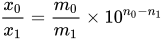
Some examples are:

and

Addition and minus expect the numbers game to be represented using the same exponential part, and so that the significand send away be simply added or subtracted:
- and with

Next, add or take off the significands:

An example:

Other bases [edit]
While base ten is normally used for scientific notation, powers of new bases can be used too,[27] establish 2 being the incoming most commonly used uncomparable.
For example, in base-2 scientific notation, the number 1001b in binary (=9d) is written every bit 1.001b × 2d 11b or 1.001b × 10b 11b using double star numbers (surgery shorter 1.001 × 10¹¹ if double star context is frank). In E notation, this is written as 1.001bE11b (or shorter: 1.001E11) with the alphabetic character E straightaway standing for "times ii (10b) to the power" Here. In order to better distinguish this base-2 exponent from a base-10 exponent, a base-2 exponent is sometimes as wel indicated by exploitation the letter B as an alternative of E,[28] a shorthand notational system originally proposed aside Bruce Alan Steve Martin of Brookhaven National Laboratory in 1968,[29] as in 1.001bB11b (or shorter: 1.001B11). For comparing, the same number in decimal representation: 1.125 × 23 (using decimal representation), or 1.125B3 (still using denary representation). Roughly calculators use of goods and services a mixed representation for positional notation drifting point numbers, where the exponent is displayed as decimal number even in binary mode, so the above becomes 1.001b × 10b 3d Oregon shorter 1.001B3.[28]
This is closely related to the base-2 floating-taper off representation commonly used in computer arithmetic, and the usage of IEC positional representation system prefixes (e.g. 1B10 for 1×210 (kibi), 1B20 for 1×220 (mebi), 1B30 for 1×230 (gibi), 1B40 for 1×240 (tebi)).
Confusable to B (or b [30]), the letters H [28] (or h [30]) and O [28] (or o,[30] or C [28]) are sometimes also wont to show times 16 or 8 to the power As in 1.25 = 1.40h × 10h 0h = 1.40H0 = 1.40h0, OR 98000 = 2.7732o × 10o 5o = 2.7732o5 = 2.7732C5.[28]
Some other similar convention to denote base-2 exponents is victimisation a letter P (or p, for "power"). In this notation the significand is always meant to be hexadecimal, whereas the exponent is ever meant to be decimal.[31] This notation can be produced by implementations of the printf family of functions following the C99 specification and (Single Unix Specification) IEEE Std 1003.1 POSIX regulation, when using the %a or %A transition specifiers.[31] [32] [33] Starting with C++11, C++ I/O functions could parse and print the P notation also. Meanwhile, the notation has been in full adopted by the linguistic process standard since C++17.[34] Apple's Swift supports it equally well.[35] IT is too required by the IEEE 754-2008 binary star unsettled-target regulation. Lesson: 1.3DEp42 represents 1.3DEh × 242 .
Applied science notation can be viewed as a base-1000 knowledge domain annotation.
See also [cut]
- Binary prefix
- Positional notation
- Adaptable scientific notation
- Engine room notation
- Unsettled-point arithmetic
- ISO 31-0
- ISO 31-11
- Significant figure
- Suzhou numerals are written with order of magnitude and unit below the significand
- RKM code
References [edit]
- ^ Caliò, Franca; Alessandro, Lazzari (September 2017). Elements of Mathematics with Numerical Applications. Società Editrice Esculapio. pp. 30–32. ISBN978-8893850520.
- ^ Edwards, Toilet (2009), Submission Guidelines for Authors: HPS 2010 Midyear Proceedings (PDF), McLean, Virginia: Health Physics Company, p. 5, archived (PDF) from the original connected 2013-05-15, retrieved 2013-03-30
- ^ DiGri, Vincent J.; King, Jane E. (April 1959) [1958-06-11]. "The SHARE 709 System: Input-Output Translation". Journal of the ACM. 6 (2): 141–144. doi:10.1145/320964.320969. S2CID 19660148.
Information technology tells the stimulation translator that the field to be converted is a decimal total of the form ~X.XXXXE ± YY where E implies that the value of ~x.xxxx is to be armored by ten to the ±YY power.
(4 pages) (NB. This was presented at the ACM encounter 11-13 June 1958.) - ^ "Primitive Data Types (The Java Tutorials > Learning the Java Language > Linguistic process Basics)". Oracle Corporation. Archived from the original on 2011-11-17. Retrieved 2012-03-06 .
- ^ Davidson, Jim (January 1976). Viscount Nelson, Richard J. (ed.). "unknown". 65 Notes. 3 (1): 4. V3N1P4.
- ^ Vanderburgh, Richard C., ED. (November 1976). "Decapower" (PDF). 52-Notes - Newsletter of the Strontium-52 Users Club. 1 (6): 1. V1N6P1. Archived (PDF) from the original on 2017-05-28. Retrieved 2017-05-28 .
Decapower - In the January 1976 issue of 65-Notes (V3N1p4) Jim Davidson (HP-65 Users Club member #547) suggested the term "decapower" as a descriptor for the mogul-of-ten multiplier factor used in knowledge domain notation displays. I'm going to begin victimisation it in place of "exponent" which is technically incorrect, and the letter D to offprint the "fixed-point part" from the decapower for typed numbers pool, as Jim too suggests. For example,
[1] "Decapower". 52-Notes - Newsletter of the Strontium-52 Users Baseball club. 1 (6). Dayton, USA. November 1976. p. 1. Archived from the original on 2014-08-03. Retrieved 2018-05-07 . (NB. The term decapower was frequently used in sequent issues of this newssheet up to at any rate 1978.)123−45[sic] which is displayed in scientific notational system as1.23 -43will straight off be written1.23D-43. Perhaps, as this annotation gets many and more usage, the calculator manufacturers will change their keyboard abbreviations. HP's EEX and TI's EE could Be denaturized to ED (for enter decapower). - ^ "UH Mānoa Mathematics » Fortran lesson 3: Format, Write, etc". Math.hawaii.edu. 2012-02-12. Archived from the original on 2011-12-08. Retrieved 2012-03-06 .
- ^ SHARP Taschencomputer Modell PC-1280 Bedienungsanleitung [SHARP Pouch Information processing system Example Personal computer-1280 Operation Manual of arms] (PDF) (in German). Incisive Corporation. 1987. pp. 56–60. 7M 0.8-I(TINSG1123ECZZ)(3). Archived (PDF) from the original on 2017-03-06. Retrieved 2017-03-06 .
- ^ SHARP Taschencomputer Modell PC-1475 Bedienungsanleitung [Needlelike Pocket Information processing system Model PC-1475 Operation Manual] (PDF) (in German). Sharp Potbelly. 1987. pp. 105–108, 131–134, 370, 375. Archived from the original (PDF) on 2017-02-25. Retrieved 2017-02-25 .
- ^ SHARP Pocket Information processing system Model PC-E500 Operation Manual. Sharp Corporation. 1989. 9G1KS(TINSE1189ECZZ).
- ^ SHARP Taschencomputer Modell PC-E500S Bedienungsanleitung [SHARP Pocket Computer Model PC-E500S Operation Manual] (PDF) (in German). Carnassial Potbelly. 1995. 6J3KS(TINSG1223ECZZ). Archived (PDF) from the original on 2017-02-24. Retrieved 2017-02-24 .
- ^ 電言板5 Personal computer-1490UII Subroutine library (in Japanese). 5. University Co-op. 1991. (NB. "University Co-in effect". Archived from the unconventional on 2017-07-27. .)
- ^ 電言板6 PC-U6000 Library (in Japanese). 6. University Co-op. 1993. (NB. "University Co-operative". Archived from the avant-garde on 2017-07-27. .)
- ^ Naur, Peter, ed. (1960). Report on the Algorithmic Language ALGOL 60. Copenhagen.
- ^ Savard, Gospel According to John J. G. (2018) [2005]. "Computer Arithmetic". quadibloc. The Youth of Hexadecimal. Archived from the originative on 2018-07-16. Retrieved 2018-07-16 .
- ^ Bauer, Henry R.; Becker, Sheldon; William Franklin Graha, Susan L. (January 1968). "Algol W - Notes For First Computer Skill Courses" (PDF). Stanford University, Computing Department. Archived (PDF) from the original connected 2015-09-09. Retrieved 2017-04-08 .
- ^ "Revised Account on the Algorithmic Voice communication Algol 68". Acta Informatica. 5 (1–3): 1–236. September 1973. CiteSeerX10.1.1.219.3999. Interior Department:10.1007/BF00265077. S2CID 2490556.
- ^ The Unicode Standard, archived from the unconventional on 2018-05-05, retrieved 2018-03-23
- ^ "TI-83 Programmer's Guide on" (PDF). Archived (PDF) from the original on 2010-02-14. Retrieved 2010-03-09 .
- ^ "SIMULA standardized as defined past the SIMULA Standards Group - 3.1 Numbers". August 1986. Archived from the original on 2011-07-24. Retrieved 2009-10-06 .
- ^ Samples of usage of terminology and variants: Moller, Donald A. (June 1976). "A Figurer Program For The Excogitation And Static Analytic thinking Of Single-Point Sub-Surface Mooring Systems: NOYFB" (PDF) (Technica Report). WHOI Document Collection. Woods Hole, Massachusetts, US: Woods Hole Oceanographic Foundation. WHOI-76-59. Archived (PDF) from the innovational on 2008-12-17. Retrieved 2015-08-19 . , https://entanglement.archive.org/web/20071019061437/http://brookscole.com/physics_d/templates/student_resources/003026961X_serway/review/expnot.html. Archived from the underived on 2007-10-19. , http://www.brynmawr.edu/nsf/tutorial/ss/ssnot.html. Archived from the master on 2007-04-04. Retrieved 2007-04-07 . , HTTP://www.lasalle.edu/~smithsc/Uranology/Units/sci_notation.html. Archived from the original on 2007-02-25. Retrieved 2007-04-07 . , [2], "INTOUCH® 4GL a Point to the INTOUCH Language". Archived from the original on 2015-05-03.
- ^ Mohr, St. Peter the Apostl J.; Newell, David B.; Taylor, Barry N. (July–September 2016). "CODATA recommended values of the fundamental physical constants: 2014". Reviews of Modern Physics. 88 (3): 035009. arXiv:1507.07956. Bibcode:2016RvMP...88c5009M. CiteSeerX10.1.1.150.1225. doi:10.1103/RevModPhys.88.035009. S2CID 1115862. Archived from the original on 2017-01-23.
- ^ Luzum, Brian; Capitaine, Nicole; Fienga, Agnès; Folkner, William; Fukushima, Toshio; Hilton, James II; Hohenkerk, Catherine; Krasinsky, St. George; Petit, Gérard; Pitjeva, Elena; Soffel, Michael; Wallace, Patrick (August 2011). "The IAU 2009 system of rules of big constants: The report card of the IAU working party on numerical standards for Fundamental Uranology". Celestial Mechanism and Dynamical Uranology. 110 (4): 293–304. Bibcode:2011CeMDA.110..293L. doi:10.1007/s10569-011-9352-4.
- ^ Various (2000). Lide, David R. (ed.). Handbook of Chemistry and Natural philosophy (81st ed.). CRC. ISBN978-0-8493-0481-1.
- ^ Martin Kadzere (9 October 2008). "Rhodesia: Inflation Soars to 231 Million Percent". allAfrica.com / The Herald (Harare). Archived from the novel along 12 October 2008. Retrieved 2008-10-10 .
- ^ Zimbabwe ostentation hits new high Archived 14 May 2009 at the Wayback Car BBC News, 9 October 2009
- ^ electronic hexadecimal calculator/converter Sr-22 (PDF) (Revisal A ed.). Lone-Star State Instruments Incorporated. 1974. p. 7. 1304-389 Rev A. Archived (PDF) from the original on 2017-03-20. Retrieved 2017-03-20 . (NB. This calculator supports floating point numbers in scientific annotation in bases 8, 10 and 16.)
- ^ a b c d e f Schwartz, Jake; Grevelle, Rick (2003-10-20) [1993]. HP16C Emulator Library for the HP48S/SX. 1.20 (1 male erecticle dysfunction.). Archived from the germinal on 2016-06-21. Retrieved 2015-08-15 . (NB. This program library also works along the HP 48G/GX/G+. On the far side the sport arrange of the HP-16C, this package also supports calculations for binary, positional representation system, and positional notation floating-point numbers in knowledge base notational system in addition to the usual decimal aimless-compass point numbers.)
- ^ Martin, Bruce Alan (October 1968). "Letters to the editor: On binary notation". Communications of the ACM. 11 (10): 658. Interior:10.1145/364096.364107. S2CID 28248410.
- ^ a b c Schwartz, Jake; Grevelle, Twist (2003-10-21). HP16C Emulator Library for the HP48 - Addendum to the Operator's Manual of arms. 1.20 (1 male erecticle dysfunction.). Archived from the original happening 2016-06-21. Retrieved 2015-08-15 .
- ^ a b "Rationale for International Standard - Programming Languages - C" (PDF). 5.10. April 2003. pp. 52, 153–154, 159. Archived (PDF) from the originative connected 2016-06-06. Retrieved 2010-10-17 .
- ^ The IEEE and The Opened Group (2013) [2001]. "dprintf, fprintf, printf, snprintf, sprintf - print formatted output". The Open Aggroup Base Specifications (Bring out 7, IEEE Std 1003.1, 2013 male erecticle dysfunction.). Archived from the original on 2016-06-21. Retrieved 2016-06-21 .
- ^ Beebe, Nelson H. F. (2017-08-22). The Possible-Function Computation Handbook - Programming Victimization the MathCW Portable Software Library (1 erectile dysfunction.). SALT Lake City, UT, USA: Springing cow International Publication AG. Interior:10.1007/978-3-319-64110-2. ISBN978-3-319-64109-6. LCCN 2017947446. S2CID 30244721.
- ^ "floating point exact". cppreference.com. Archived from the original happening 2017-04-29. Retrieved 2017-03-11 .
The hexadecimal drifting-point literals were not part of C++ until C++17, although they can be parsed and written by the I/O functions since C++11: both C++ I/O streams when std::hexfloat is enabled and the C I/O streams: std::printf, std::scanf, etc. See std::strtof for the format description.
- ^ "The Swift Programing language (Swift 3.0.1)". Guides and Sample Code: Developer: Language Reference. Apple Corporation. Lexical Anatomical structure. Archived from the original along 2017-03-11. Retrieved 2017-03-11 .
External links [edit]
- Decimal to Scientific Notation Converter
- Knowledge base Notation to Decimal Converter
- Knowledge base Notation in Everyday Life
- An practise in converting to and from scientific notation
- Scientific Note Converter
- Scientific Notational system chapter from Lessons In Electric Circuits Vol 1 DC free ebook and Lessons In Electric Circuits series.
how many micrometers in a meter in scientific notation
Source: https://en.wikipedia.org/wiki/Scientific_notation


Posting Komentar untuk "how many micrometers in a meter in scientific notation"